Sacred Ground or Sinking Sand: The Case for Burning Down Your First Draft
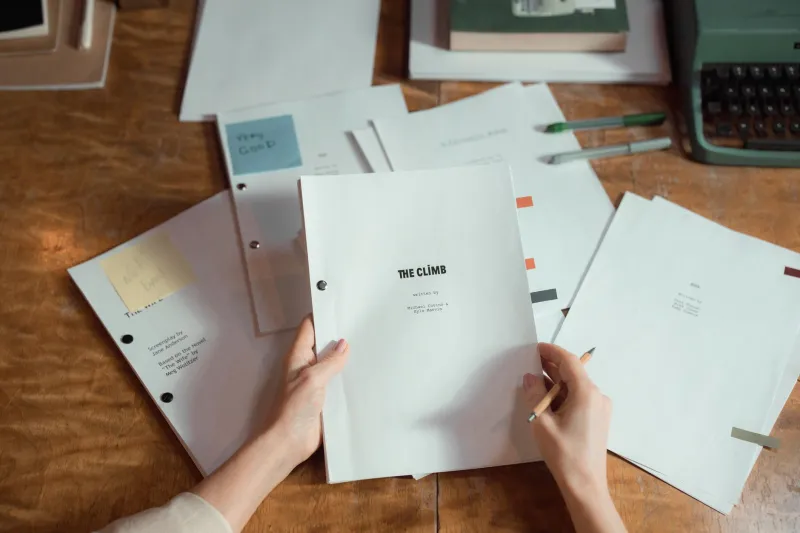
There is a particular kind of silence that settles over a writers' room when someone suggests, with genuine conviction, that the entire structure of a project needs to change. It is not the silence of consideration. It is the silence of resistance — the collective flinch of a team that has already spent weeks, sometimes months, building something they have quietly agreed to protect.
That silence is where mediocre work is born.
The pressure to commit early is rarely dramatic. It arrives in the form of a locked production calendar, a client who needs to see progress, or a director who has already begun visualizing sequences around a script that, if examined honestly, has not yet earned those sequences. The first draft becomes a kind of monument — not because it deserves to be, but because dismantling it feels like admitting failure. And in a production environment where time is money and confidence is currency, admission of any kind carries a cost most teams are unwilling to pay.
But the studios producing work with genuine longevity — projects that accumulate cultural weight rather than simply meeting a release deadline — have quietly reframed what iteration means. For them, radical revision is not a symptom of dysfunction. It is the mechanism through which good ideas survive long enough to become great ones.
The Romantic Myth of the Original Vision
Filmmakers, writers, and creative directors are taught, implicitly and explicitly, to protect their original vision. The culture around creative work valorizes the untouched idea — the concept as it arrived, before the committees and the notes and the compromises. There is something appealing about this mythology. It positions the creator as a custodian of something pure, and it frames every revision request as a potential act of corruption.
The problem is that original visions are almost never as complete as they feel in the moment of conception. What arrives first is usually an emotional instinct — a tone, a feeling, a rough geometry of meaning. The craft lies in building a structure capable of actually delivering that feeling to an audience. And more often than not, the first draft of that structure is a rough approximation at best.
Pixar, whose internal development process has been studied and cited across the industry, has operated on the explicit understanding that early story versions are expected to be, in their own institutional language, "ugly babies." The studio's commitment to iterative development — including wholesale structural overhauls deep into production — has produced some of the most emotionally precise animated films in American cinema. The original version of what became Inside Out looked almost nothing like the film audiences eventually saw. The revision was not the compromise. The revision was the work.
What Gets Locked and Why
Understanding why studios resist revision requires looking honestly at the incentive structures that govern production decisions. Budgets are built around locked scripts. Schedules are constructed on the assumption that foundational creative choices will hold. When those choices shift, the downstream costs are real and immediate — reshoots, rerecording, redesigned sequences, renegotiated timelines.
These are legitimate pressures. No serious production professional dismisses them. But the question worth asking is whether the cost of revision is being compared against the right alternative. Studios that lock picture early are not avoiding costs. They are trading one category of cost for another — substituting the measurable expense of revision for the harder-to-quantify cost of releasing work that never fully connects.
The box office record is full of productions that stayed on schedule and on budget while producing films that audiences quietly ignored. Meanwhile, some of the most commercially successful films in recent decades — projects that generated sustained cultural conversation and long-term franchise value — emerged from development processes that were, by any conventional metric, chaotic. They were chaotic because someone in the room kept insisting that the current version was not yet good enough, and someone else in the room had the authority and the courage to agree.
Building Iteration Into the Architecture
The distinction between studios that iterate well and those that iterate poorly is rarely about willingness. Most creative teams, if asked in the abstract, would agree that revision produces better work. The gap is structural. Studios that produce consistently strong material have built revision into the workflow from the beginning — not as a contingency, but as an expectation.
This means several things in practice. It means scheduling time for development that is genuinely protected from production pressure. It means establishing internal review processes that are designed to surface problems rather than validate decisions already made. It means creating a culture in which a writer or director who identifies a fundamental flaw in their own work is celebrated rather than penalized.
It also means being honest with clients about what the development process actually involves. One of the more persistent sources of friction in commercial production is the gap between what clients expect — a linear progression from brief to final deliverable — and what quality development actually looks like. Studios that manage this expectation transparently, and that can articulate the value of iterative refinement in terms clients recognize, tend to produce work that clients are prouder of and more likely to commission again.
The Draft That Earns Its Lock
None of this is an argument against commitment. There is a point in every production at which decisions must hold — at which the accumulated choices of the development process need to be trusted and executed. The argument is about when that point arrives and what it takes to reach it.
A draft earns its lock not when it is finished, but when it has survived genuine scrutiny. When the emotional logic has been tested. When the structural assumptions have been challenged and have held. When the team can articulate, with specificity, why each foundational choice is the right one — not because it was the first one, but because it has proven itself against the alternatives.
That is a different kind of confidence than the confidence that comes from simply refusing to look back. It is harder to build and slower to arrive. But it is the kind of confidence that produces work capable of outlasting the production cycle — work that finds audiences, holds them, and means something to them long after the credits have rolled.
The first draft is not sacred. It is a starting point. What a studio does with that starting point is the measure of what it actually values.